Every pupil should have access to experiences that build confidence, develop wider skills and bring learning to life. However, the opportunities available to children still vary considerably between schools and communities.
The Government’s new enrichment expectations cover five areas:
- civic engagement
- arts and culture
- nature, outdoor and adventure
- sport and physical activity
- wider life and future skills
These ambitions are welcome, but delivering them will not be simple. Schools are already balancing curriculum demands, staff workload, limited funding and increasingly complex pupil needs.
With the revised national curriculum due to be published in spring 2027, how can schools close the enrichment gap without placing even more pressure on teachers?
What Is the Enrichment Gap?
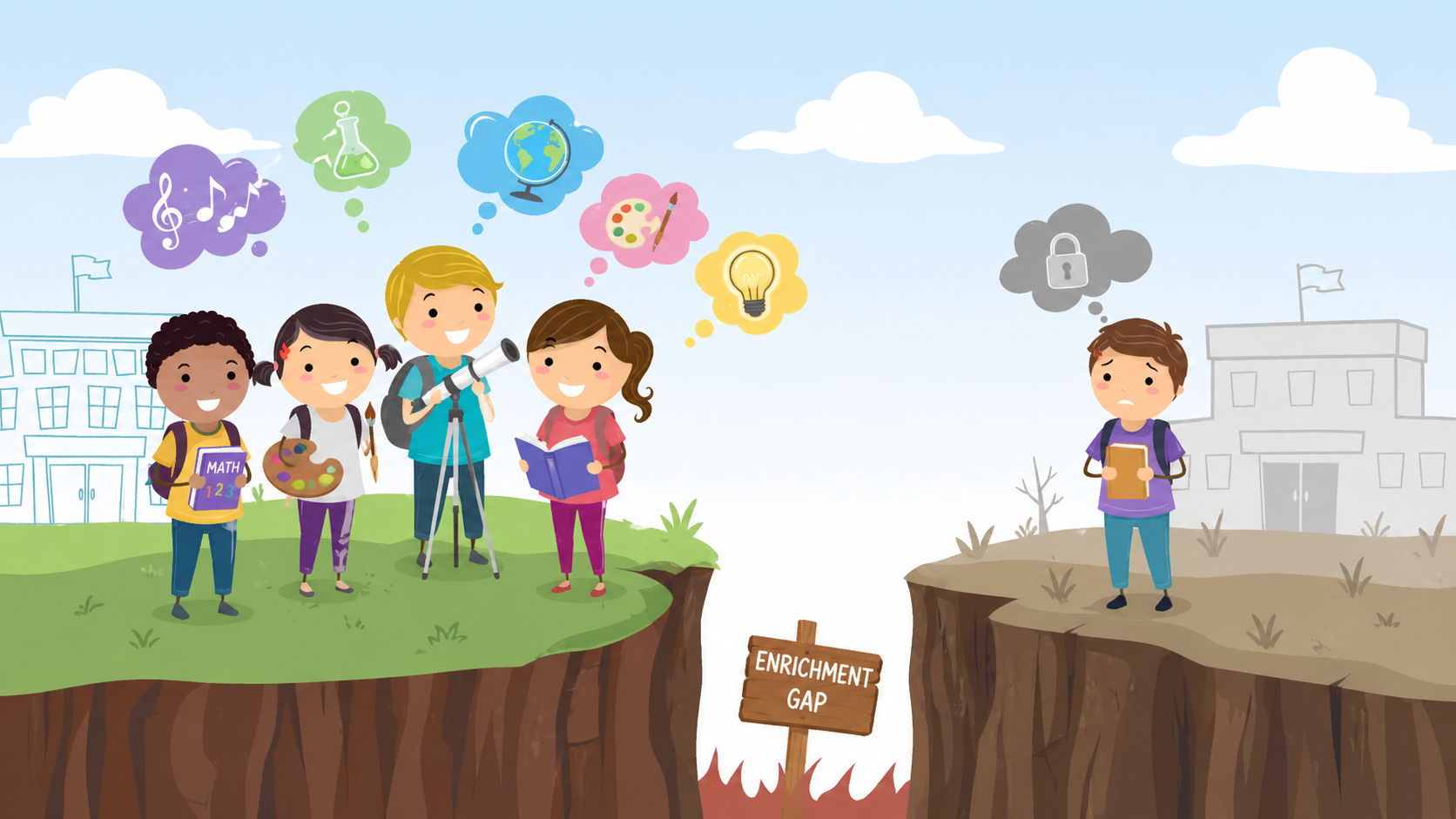
The enrichment gap is the difference between the experiences available to pupils from different backgrounds.
Some children regularly access sports clubs, outdoor activities, cultural visits and residential experiences. Others may miss out because of cost, transport, location, additional needs or limited provision in their school.
Research from the Sutton Trust has previously highlighted significant differences in access to extracurricular activities between pupils from different socioeconomic backgrounds.
This matters because enrichment develops more than knowledge. It can help pupils build:
- confidence and independence
- communication and teamwork
- resilience and problem-solving
- physical and mental wellbeing
- new interests and aspirations
- a stronger sense of belonging
If access depends on family income or where a child lives, enrichment can widen existing inequalities rather than reduce them.
What Are Schools Expected to Provide?
The Government’s enrichment benchmarks encourage schools to provide a broad, accessible and outcomes-focused offer.
Provision should be:
- supported by school leaders and governors
- connected to curriculum and school priorities
- accessible to all pupils
- shaped by pupil and community needs
- delivered with suitable partners
- monitored and continually improved
The Government has also set an ambition to halve the participation gap in enriching activities between disadvantaged young people and their peers by 2035.
Schools have a vital role to play, but they cannot close this gap through additional clubs and trips alone.
Why Are Schools Struggling?
Limited Funding
Trips, transport, equipment, facilities and specialist instructors all cost money. Schools in disadvantaged communities may also be supporting families who cannot contribute towards activities.
Even where funding is available, short-term grants can make it difficult to build sustainable provision.
Teacher Workload
High-quality enrichment requires planning, coordination, communication and evaluation. Adding more activities without providing time or practical support risks creating another demand for already stretched staff.
Our article on reducing teacher stress and workload explores how ready-made resources and automatic reporting can reduce this pressure.
Unequal Access
After-school activities may unintentionally exclude pupils who rely on school transport, have caring responsibilities or cannot afford to participate.
Pupils with SEND may also face physical, sensory or communication barriers if activities have not been designed inclusively.
Lack of Staff Confidence
Teachers may be enthusiastic about outdoor learning, OAA or enrichment but feel they lack the training or resources to deliver it safely and effectively.
Without a clear structure, enrichment can become dependent on individual members of staff rather than being embedded across the school.
Bringing Enrichment into the School Day
One of the most effective ways to reduce the enrichment gap is to include meaningful experiences within curriculum time.
Outdoor learning can support this by combining curriculum content, physical activity and wider personal development. Schools can use their own grounds for:
- science investigations
- geography fieldwork
- maths and literacy trails
- orienteering and OAA
- environmental projects
- teamwork challenges
- active wellbeing activities
This ensures every pupil can participate, including children who may not attend clubs, residentials or activities outside school.
The aim is not to replace special trips and experiences. It is to create a reliable foundation of enrichment that reaches every child.
Making Existing Resources Work Harder
Closing the enrichment gap does not always require expensive new facilities. Playgrounds, fields and other familiar spaces can provide valuable opportunities when used creatively.
A mapped school site and permanent orienteering points, for example, can support PE, geography, maths, English, science and whole-school competitions.
The Outdoor Classroom allows teachers to turn these spaces into an active learning resource. Pupils navigate between checkpoints and complete curriculum questions, challenges or investigations.
Teachers can use ready-made content, create their own activities or automatically generate courses, helping enrichment become repeatable rather than a one-off event.
Designing Enrichment for Everyone
Schools should consider who might be missing from their current offer.
Useful questions include:
- Do all year groups have regular opportunities?
- Can pupils with SEND participate meaningfully?
- Are activities available during the school day?
- Are disadvantaged pupils participating at the same rate?
- Does the offer reflect pupil interests?
- How are participation and impact recorded?
Activities can be made more inclusive through accessible routes, different challenge levels, team roles and a mixture of visual, written and audio instructions.
The Youth Sport Trust and Learning Through Landscapes also provide resources to help schools develop inclusive physical activity and outdoor learning.
Working in Partnership
Schools are not expected to provide every experience independently.
Local sports clubs, community groups, outdoor organisations and School Sport Partnerships can offer training, resources and specialist knowledge.
Organisations such as British Orienteering can also help schools develop navigation and OAA opportunities that connect curriculum learning with physical activity.
Effective partnerships should build staff confidence and leave schools with provision they can continue using—not simply deliver an isolated activity and disappear.
Final Thoughts
The new enrichment expectations create an opportunity to give every pupil broader and more memorable experiences. But ambition must be matched by practical delivery.
Schools can begin closing the enrichment gap by embedding opportunities within the school day, using existing spaces more effectively, designing activities inclusively and reducing unnecessary planning.
Outdoor learning cannot solve every inequality, but it can provide an accessible starting point—helping more children experience nature, adventure, movement and success as part of their everyday education.
Create a free teacher account and explore how The Outdoor Classroom can support an inclusive enrichment offer.